
Pet Urine Smell Removal- How to get this potent smell out of your upholstery
If you live with a dog or a cat on the KwaZulu-Natal North Coast, you already know the smell. The lounge looks clean. You have vacuumed. You have sprayed something from the supermarket. For a few days the room smells fine. Then the humidity climbs, a summer storm rolls in off the Indian Ocean, or you open the doors at Simbithi, Zimbali, Salt Rock or Sheffield Beach after a beach walk, and the pet urine smell is back in the carpet as if nothing was ever cleaned.
That is not your imagination, and it is not a sign that you are a bad pet owner. It is chemistry. Pet urine does not behave like red wine, coffee or mud. Those stains sit mostly in the carpet fibre. Dog pee and cat urine travel through the pile, into the backing, and often into the underlay. What is left behind is uric acid. Uric acid dries into tiny crystals. Those crystals are almost insoluble in ordinary water. When the air gets damp, which it does for much of the year from Umhlanga to Zinkwazi, the crystals take on moisture and release the smell again.
North Coast Cleaning has spent more than twelve years deep-cleaning carpets, couches, mattresses and curtains in Ballito, Salt Rock, Umhlanga, Tongaat, La Mercy, Sheffield Beach, Tinley Manor, Blythedale, Prince’s Grant and Zinkwazi. Pet urine smell removal is one of the jobs homeowners book when every home remedy has already failed. This guide explains why the smell returns, what actually removes pet urine from carpet, what to avoid, and when a professional enzyme and deep extraction clean is the only realistic fix. Contact us today when your furry family has had an accident on your upholstery.
Why pet urine smell is one of the most searched carpet problems
People do not search “carpet cleaning” only when a room looks tired. They search when a carpet is dirty or a smell will not leave. Queries such as “how to get pet urine smell out of carpet”, “dog pee smell in carpet won’t go away”, “cat urine smell in carpet after cleaning” and “remove pet odour from carpet” are among the highest-intent searches in the cleaning industry. The person typing those words has usually already tried baking soda, white vinegar, a carpet shampooer and an air freshener. They are ready for an answer that works.
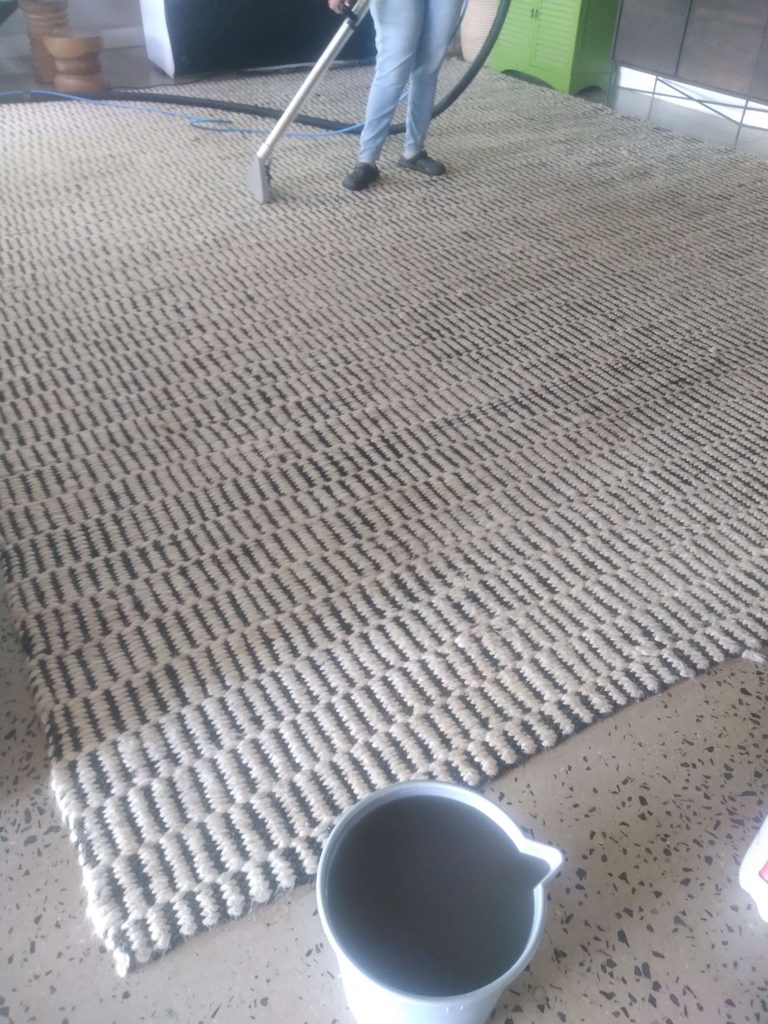
On the North Coast the problem is sharper than it is inland. Durban and the Ballito coastline sit in a warm, humid subtropical climate. Relative humidity regularly sits high enough to wake dried residues in fabric. A carpet that seems acceptable in a dry week can smell strongly after rain, after a closed-up holiday home is reopened, or after a hot day with the air conditioner off. Holiday homes and estate houses in Zimbali, Simbithi, Brettenwood, Seaton, Palm Lakes and Prince’s Grant are especially prone to this, because rooms are shut for weeks, pets visit with family, and moisture has time to sit in the pile.
What is actually in pet urine, and why carpets hold it
Fresh pet urine is mostly water. It also contains urea, ammonia, creatinine, salts, proteins and uric acid. The water evaporates. The ammonia is what hits you first: sharp, unmistakable, embarrassing when guests walk in. Ammonia fades. Uric acid does not.
As the spot dries, uric acid forms crystals that bond to carpet fibres and to the latex backing. Those crystals do not rinse away with a bucket of soapy water. Standard detergents can lift dirt and some proteins. They do not break the crystal structure. Bacteria in the residue keep breaking down what is left, which is why an old accident can smell worse than a fresh one, and why a spot you thought you cleaned six months ago can announce itself again in February humidity.
Carpet is the worst household surface for this. The pile acts like a wick. Liquid moves sideways as well as down, so the smell zone is often larger than the visible mark. Wool and wool-blend carpets, common in older North Coast homes, hold odour differently from synthetic cut pile and frieze. Loop pile in passages shows tracking. A loose rug can be lifted. Wall-to-wall carpet cannot. If the underlay is foam and it is saturated, surface cleaning alone will not finish the job.
Why the smell comes back when Ballito humidity rises
This is the part most DIY articles skip, and it is the reason so many North Coast homes call us after a “successful” home clean.
Uric acid crystals are stable when they are dry. Add moisture and the surface of the crystal softens. Bacterial by-products and ammonia compounds are released into the air. You smell the dog pee again. On the KZN coast that moisture does not only come from a spill. It comes from the weather. Summer afternoons, onshore winds, closed rooms in a holiday apartment, a carpet that was shampooed and left damp, even steam from a nearby bathroom can be enough.
That is also why some professional cleans fail if the technician only extracts and deodorises. Water extraction without an enzyme pre-treatment adds moisture. Moisture reactivates crystals that were never broken down. The room smells stronger for a day, then “fine”, then the next humid front brings the odour back. Homeowners often blame the carpet cleaner. The real issue is that perfume and detergent cannot digest uric acid.
Coastal living adds two more layers. Salt air and fine beach sand work into the pile and hold moisture against the fibre. Pollen and garden dust from estate planting give bacteria more to feed on. If a dog comes in wet from Christmas Bay, Sheffield Beach or Blythedale and lies in the same corner every evening, that patch stays slightly damp longer than the rest of the room. Odour and dull traffic lanes show up together.
Why baking soda, vinegar and supermarket sprays disappoint
There is a reason these remedies dominate the first page of Google. They are cheap, and on a fresh surface drip they can reduce the first wave of ammonia. They are a poor match for set-in pet urine in carpet.
White vinegar is acidic. It can neutralise some alkaline residue and reduce ammonia smell for a short time. It does not reliably dissolve uric acid crystals bonded in the backing. Used too wet, it drives the contamination deeper and leaves a sour note of its own. Baking soda absorbs some odour molecules at the surface and makes the carpet look as if you have done something. Vacuum it up the next day and the crystals are still there. Supermarket enzyme sprays are often too dilute, left on for too little time, and never flushed out. If the enzyme does not stay in contact with the uric acid long enough, and if the residue is not extracted, you have perfumed the problem.

A rented carpet shampooer has the same limit. Most add more water than they remove. On a humid Ballito afternoon that extra moisture is a gift to whatever uric acid is left in the underlay. Over-wetting is one of the fastest ways to turn a pet accident into a musty, mould-adjacent smell. We see this in holiday lets where a manager has tried to “freshen” a unit between guests and the next arrival still comments on the dog.
Other mistakes we are asked to correct:
- Rubbing the spot, which spreads urine sideways through the pile and felts wool.
- Bleach or strong ammonia, which can set colour damage and add another smell.
- Covering the area with a rug or furniture so the smell is trapped.
- Steam-cleaning the whole room without finding every old accident, so untreated spots reactivate next to clean ones.
- Assuming that if you cannot see a stain, there is no urine. Many deposits leave no colour at all.
- If only the obvious lounge patch is treated, the smell simply moves to the next strongest source once that patch is quieter.
What actually removes pet urine smell from carpet
Lasting pet odour removal has to do three things. It has to find the full contamination zone, including backing and, where needed, underlay. It has to break down uric acid and the proteins bacteria feed on, not mask them. It has to remove the broken-down material and the moisture so the carpet or couch can dry in coastal air.
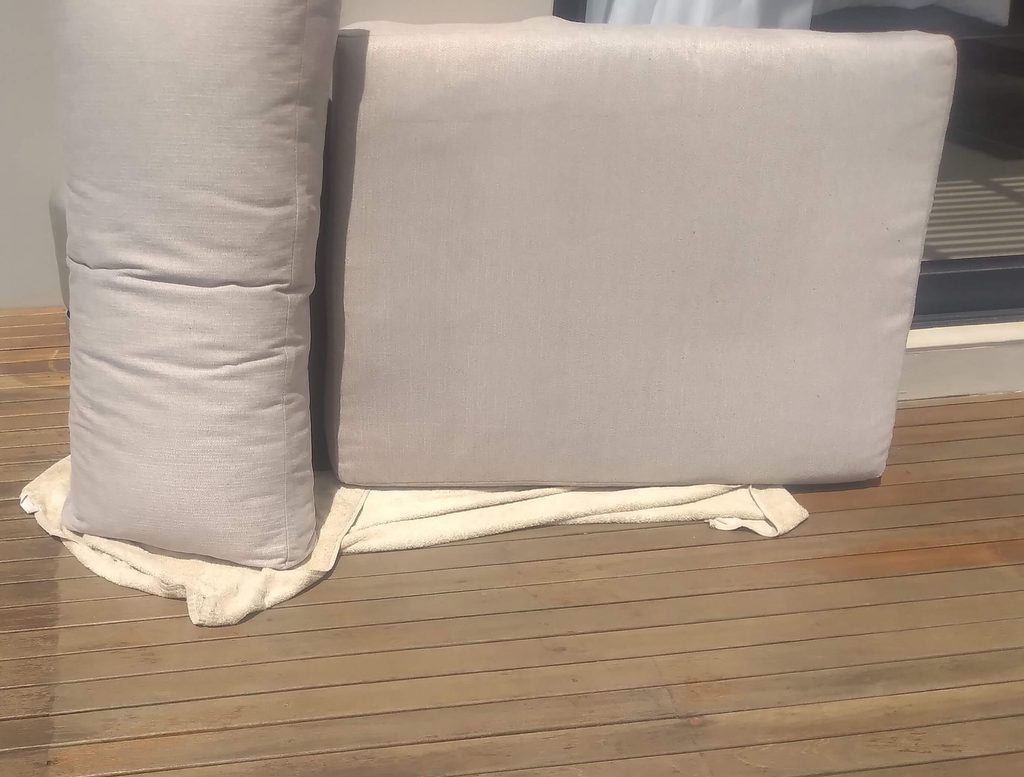
First, the area is assessed. We look at fibre type, how old the accidents are, whether the smell is in one room or through the passage, and whether upholstery, curtains or a mattress are involved. A dog that sleeps on the couch has usually transferred oils and dander there even if the accidents were on the floor. A cat that sprays may have marked a curtain hem or a leather sofa arm.
Second, an enzyme pre-treatment is applied to the urine zone and given proper dwell time. Professional enzyme chemistry targets the compounds in pet urine, including uric acid, so the crystals are broken into smaller, water-soluble by-products. This is the step supermarket sprays imitate and usually under-dose. Dwell time matters. Enzymes are biological catalysts. They need contact, the right dilution and enough time. Rushing this step is why odour returns.
Third, the carpet is cleaned with professional water extraction. Specialized solution and strong vacuum pull the loosened soil, bacteria and enzyme residue out of the pile. Extraction is not the same as a domestic machine that leaves the carpet soggy. Our equipment is built for deep extraction, and we use high-power fans to speed drying, which matters when humidity is already high. A carpet that dries quickly is less likely to develop a secondary musty smell.
Fourth, the room is checked. If odour is still coming from the underlay, from a tucked edge, or from a second unmarked spot, that area is treated before we leave. On some severe, repeated accidents the underlay itself is too contaminated to save and a section may need replacement. Pet odour treatment takes 4-7 days to kill the odour causing bacteria.
Coastal homes, holiday lets and estate living
Pet odour on the North Coast is rarely only a cleaning problem. It is a property problem.
Holiday apartments and short-stay houses in Ballito, Salt Rock and Umhlanga lose bookings over smell faster than over a scuff on a wall. Guests mention it in reviews. A manager who masks the room with candles between stays is renting out a complaint. Enzyme treatment and extraction before the season, and again if a pet-friendly booking leaves a mark, protects the listing.
Estate homes have their own pattern. Secure estates such as Simbithi, Zimbali, Seaton, Brettenwood, Palm Lakes, Prince’s Grant and Caledon are full of families with dogs. Sand comes in from the beach. Dogs lie on the same rug. Rooms are large, so a smell can seem to have no source until you are standing on it.
Commercial spaces are not exempt. A veterinary waiting room, a groomer, a pet-friendly café or a home office where a dog spends the day will load carpet faster than a spare bedroom. Office carpet cleaning and pet odour treatment can be scheduled together so staff are not working in a room that smells of last week’s accident.
How often pet homes on the North Coast should deep-clean carpets
There is no single calendar that fits every house. A couple with no pets and low traffic may only need professional carpet cleaning once a year. A Ballito home with two dogs, children and sliding doors onto a patio is a different building.
As a practical guide for KZN coastal homes:
- No pets, light use: professional carpet cleaning about every 12 months.
- Family home, no regular accidents: every 6 to 12 months.
- Dogs or cats using carpeted rooms: every 3 to 6 months.
- Known urine accidents or a returning smell: as soon as the smell is noticed, then a maintenance clean on the shorter cycle.
- Allergy symptoms that flare indoors: every 3 to 6 months, including mattresses and upholstery, not only floors.
- Holiday home opened for December: a pre-season clean, and a post-season clean if pets stayed.
Couches in pet homes often need the same 3 to 6 month rhythm if animals sleep on them. Mattresses should be sanitised on their own schedule. They collect dust mites and skin cells even when pets are banned from the bed, and coastal humidity makes that reservoir more active. Curtains collect airborne dander. A pet odour plan that ignores the sofa and the drapes often leaves a faint smell the carpet clean cannot explain.
Health, allergies and indoor air on a humid coast
Pet urine is an odour problem first. It is also an indoor air problem. Residue feeds bacteria. Damp carpet after a poor clean can grow mould. Dust mite populations do better in warm, humid rooms with a steady supply of skin cells in the pile. People with asthma, sinus trouble or pet allergies often notice the house before they notice a stain.
Professional extraction does not turn a home into a laboratory. It does remove a large share of the dust, dander, bacteria and urine residue that ordinary vacuuming leaves behind. For families on the North Coast who already battle humidity, that difference is why a scheduled clean outperforms another bottle of room spray. Pair it with a mattress clean and, where drapes are heavy, a curtain clean, and the room stops holding yesterday’s air.
How to choose a pet odour cleaner in Ballito and the North Coast
North Coast Cleaning is a local Ballito team, not a national call centre. Erika Hardwich built the company, every job is supervised, and the work covers carpet, upholstery, leather, mattresses, curtains, blinds, tile and grout, and pet odour treatment across the North Coast. Phone +27 73 904 3402 or book a professional clean online if the smell has already survived your own attempts.